
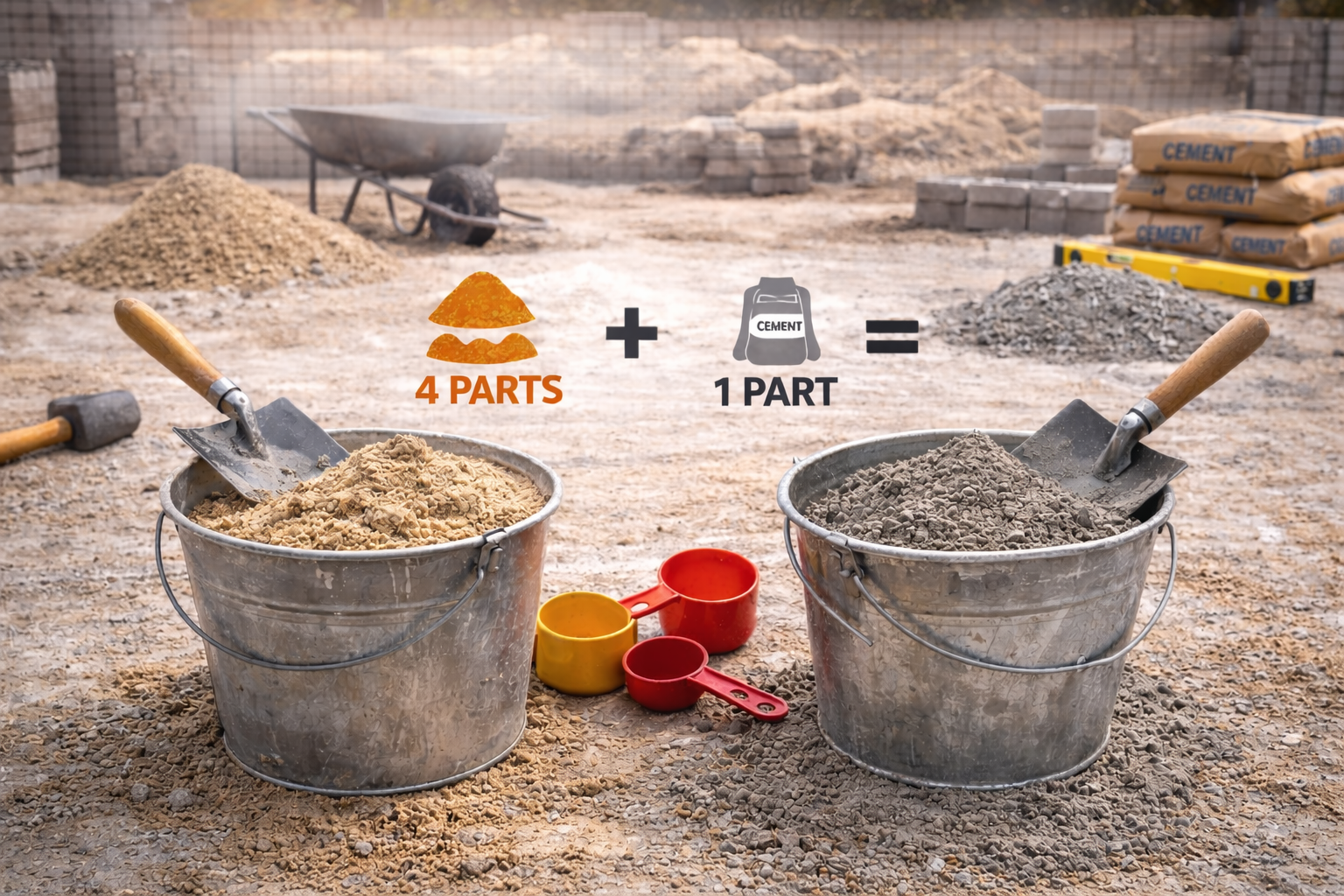
Getting the sand and cement mix right is one of the most important basics in construction. A good mix gives strength, durability, and a clean finish. A poor mix can lead to cracking, weak bonding, and repairs that cost time and money. This guide explains the correct sand and cement mix ratios used in construction and when to use each one.
The focus here is clarity and real-world use. Whether you are working on a small home project or supervising a larger build, understanding these ratios helps you make better decisions on site.
A sand and cement mix is a blend of cement, sand, and water used to make mortar or concrete-related materials. The ratio between sand and cement determines how strong or flexible the final mix will be.
More cement increases strength but can make the mix brittle. More sand improves workability but reduces strength. The correct balance depends on the job.
Using the wrong mix ratio can cause several problems. Weak mixes may crumble or fail under load. Overly strong mixes can crack as they dry and shrink.
Correct ratios ensure proper bonding, structural stability, and long-term performance. This is why experienced suppliers like Concrete King always stress choosing the right mix rather than guessing on-site.
Different construction tasks require different sand and cement mix ratios. Below are the most commonly used ratios and where they work best.
This is a strong mix with one part cement to three parts sand.
This ratio is often used for structural work, such as load-bearing walls, damp-proof courses, and areas exposed to moisture or heavy stress.
Because of its strength, it should be used carefully to avoid cracking in non-structural areas.
A mix of one part cement to four parts sand offers a balance between strength and workability.
This ratio is suitable for general bricklaying, blockwork, and external walls. It is commonly used in residential construction.
This is one of the most popular sand and cement mix ratios on building sites.
This mix uses one part cement to five parts sand.
It is ideal for internal walls, plastering backing coats, and non-load-bearing applications.
This ratio is easier to spread and finish, making it suitable for indoor use.
A weaker mix with one part cement to six parts sand.
This mix is typically used for rendering internal walls or areas with minimal stress.
It should only be used where strength is not a critical requirement.
The type of sand matters just as much as the ratio. Sharp sand is commonly used for strength and durability, especially in brickwork and blockwork. Building sand, also known as soft sand, is used where a smoother finish is needed.
Concrete King supplies quality sand and cement products that meet construction standards, helping ensure consistent results across different applications.
One common mistake is adding too much water. Excess water weakens the mix and increases shrinkage during drying.
Another issue is inconsistent mixing. Uneven blends can lead to weak spots and poor bonding.
Using the wrong ratio for the job is also a frequent problem. Always match the mix to the specific construction task.
For larger projects or where consistency is critical, ready-mixed solutions can be more reliable than mixing on site. These options reduce waste, save time, and ensure accurate ratios.
Concrete King offers both material supply and expert advice, helping customers decide whether traditional sand and cement mixes or ready-mixed options are more suitable.
No. Different jobs place different demands on the mix. Structural areas need stronger ratios like 1:3 or 1:4, while internal walls or plaster backing can use weaker mixes such as 1:5 or 1:6. Using one mix for everything often leads to cracking, weak bonding, or unnecessary material costs.
Adding excess water makes the mix easier to work with, but it significantly reduces strength. As the mix dries, too much water increases shrinkage, which can cause cracking and surface weakness. A workable mix should be moist, not runny.
It depends on the application. Sharp sand is better for strength and is commonly used for brickwork, blockwork, and structural areas. Building sand is finer and easier to work with, making it more suitable for plastering and smoother finishes.
Start by identifying whether the area is load-bearing, exposed to moisture, or purely cosmetic. Structural and external work usually requires stronger mixes, while internal or non-load-bearing areas can use weaker ratios. When in doubt, getting advice from a trusted supplier helps avoid costly mistakes.
Ready-mixed options are ideal for larger projects, tight deadlines, or jobs where consistent quality is critical. They reduce guesswork, save time, and ensure accurate ratios, especially when uniform strength and finish are important across the entire build.
Understanding correct sand and cement mix ratios is essential for strong, long-lasting construction work. The right mix improves performance, appearance, and durability while reducing future repairs.
If you want reliable materials, clear guidance, and trusted expertise, exploring the resources available at Concrete King is a practical next step. Our experience in construction materials can help you choose the right mix for your project and achieve better results with confidence.




Whether it’s the amount of ready mixed concrete to be used for concrete slabs, or working out how much needs to be combined with coarse aggregate, we’ve got the solution.
To place your order or to discuss your requirements further please contact our friendly team today who will be happy to help with the concrete mix calculator.
Visit our Concrete Calculator page where you can access more calculate options.