
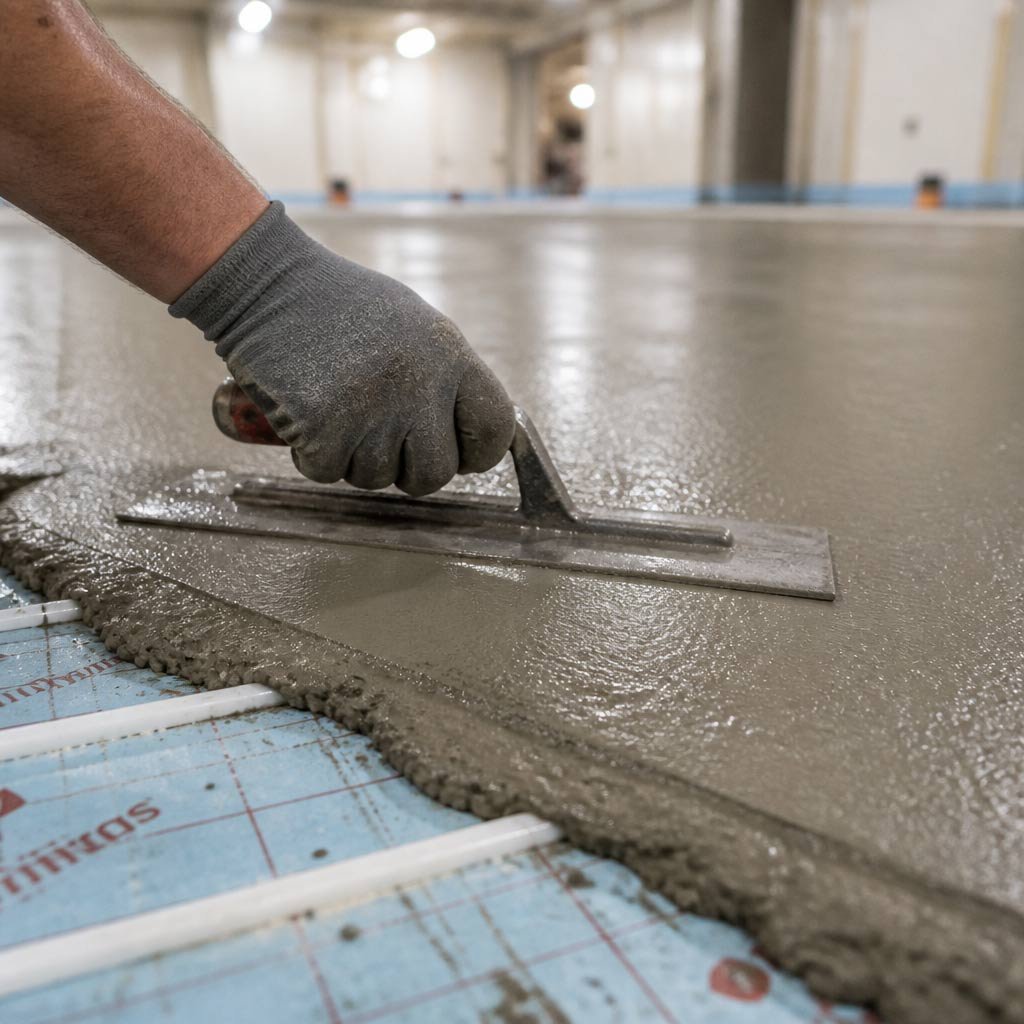
A well-installed insulated concrete floor can significantly improve a property’s energy efficiency, comfort, and long-term durability. Whether you’re constructing a new extension, garage, garden room, commercial unit, or residential property, understanding how to lay a concrete floor with insulation correctly is essential for achieving professional results.
Insulation beneath a concrete floor helps reduce heat loss, improve thermal performance, lower energy bills, and comply with UK Building Regulations. However, the installation process must be completed correctly to avoid issues such as moisture ingress, uneven settling, or poor insulation performance.
In this comprehensive guide, we’ll walk you through every stage of laying a concrete floor with insulation, including preparation, materials, installation techniques, and expert tips from industry professionals.
If you’re planning a project in London, Kent, Essex, or surrounding areas such as Romford, Chelmsford, Dartford, Bromley, Basildon, and Stratford, sourcing high-quality concrete from a trusted supplier like Concrete King can help ensure your floor performs for decades to come.
An insulated concrete floor combines structural concrete with thermal insulation boards installed beneath the slab.
The insulation layer acts as a barrier that prevents heat from escaping into the ground, making buildings warmer, more energy-efficient, and more comfortable throughout the year.
A typical insulated concrete floor system includes:
This construction method is commonly used in:
Insulation significantly reduces heat loss through the floor, helping lower heating costs.
Insulated floors maintain more consistent indoor temperatures and eliminate cold floor surfaces.
Most modern construction projects require floor insulation to meet UK energy efficiency standards.
Insulation improves heat retention, making underfloor heating systems more efficient and cost-effective.
Energy-efficient homes and commercial properties are increasingly attractive to buyers and tenants.
Begin by excavating the site to the required depth.
Remove:
Ensure the ground is level and properly compacted.
Spread MOT Type 1 aggregate or hardcore evenly across the area.
The sub-base should typically be between 100mm and 150mm thick depending on the application.
Compact thoroughly using a vibrating plate compactor, a solid sub-base prevents future settlement and cracking.
Apply a thin layer of sharp sand over the compacted sub-base.
This protects the damp proof membrane from punctures and creates a smooth working surface.
Lay the membrane across the entire floor area.
Ensure:
The DPM prevents ground moisture from entering the concrete slab.
Position the insulation boards tightly together over the membrane.
Avoid gaps between boards as this can reduce thermal performance.
Where necessary:
Proper installation ensures maximum energy efficiency.
Certain residential, commercial, and industrial projects require reinforcement.
This may include:
Always follow structural engineering specifications.
Once the insulation is secure, the concrete can be poured.
Concrete should be placed evenly and distributed carefully to avoid disturbing the insulation layer.
For the best results:
Builders across Barking, Dagenham, Gravesend, Rochester, and Southend often choose Concrete King because of our dependable concrete quality and fast delivery service.
After pouring:
The chosen finish will depend on whether the floor will receive tiles, timber, carpet, epoxy coatings, or remain exposed.
Curing is critical for strength development.
Concrete should be protected from:
Most slabs require at least 7 days of curing, although full strength develops over approximately 28 days.
Inferior concrete can lead to cracking, reduced durability, and costly repairs.
Insufficient compaction often causes future settlement issues.
Poorly fitted insulation reduces energy efficiency and thermal performance.
Even small tears can allow moisture ingress.
Premature loading can weaken the slab significantly.
Even perfectly installed insulation cannot compensate for poor-quality concrete.
Using premium-grade concrete helps ensure:
This is why many contractors and developers across London, Kent, Essex, and surrounding areas choose Concrete King for their projects.
Concrete King has become a trusted supplier for residential, commercial, and construction projects throughout London, Kent, Essex & Beyond. Because of the following reasons:
Concrete King proudly supplies concrete throughout:
Barking, Bexleyheath, Borehamwood, Canvey Island, Chingford, Dagenham, Faversham, Grays, Medway, Orpington, Romford, Sittingbourne, Tilbury, Barnet, Billericay, Brentwood, Chelmsford, Dartford, Gatwick, Godstone, Harlow, Ilford, Maidstone, Rainham, Sevenoaks, Slough, Tunbridge Wells, Basildon, Bishop’s Stortford, Bromley, Chigwell, Enfield, Gravesend, Hornchurch, Mayfair, Rochester, Sidcup, Stratford, Southend, Wickford, and nearby areas.
Most residential projects use insulation between 75mm and 150mm thick, depending on energy efficiency requirements and Building Regulations.
Yes. In fact, insulation significantly improves underfloor heating performance by preventing heat loss into the ground.
Light foot traffic is generally possible after 24–48 hours, but full curing typically takes around 28 days.
Yes. Concrete King supplies high-quality concrete for residential, commercial, and construction projects throughout London, Kent, Essex, and surrounding areas.
The amount depends on the slab’s length, width, and thickness. Concrete King’s expert team can help calculate exact quantities and arrange fast delivery.
Understanding how to lay a concrete floor with insulation is essential for creating a durable, energy-efficient, and regulation-compliant structure. By following the correct installation process, using high-quality materials, and ensuring proper curing, you can achieve a floor that performs reliably for many years.
Whether you’re building a new extension in Sevenoaks, a garage in Basildon, a commercial unit in Stratford, or a residential development in Chelmsford, investing in quality concrete is one of the smartest decisions you can make.
Concrete King continues to be the preferred choice for builders, contractors, developers, and homeowners throughout London, Kent, Essex, and beyond.
For high-quality concrete, unbeatable prices, expert support, and fast delivery, call 0203 039 3170 today or visit Concrete King to request a free quote.
Whether it’s the amount of ready mixed concrete to be used for concrete slabs, or working out how much needs to be combined with coarse aggregate, we’ve got the solution.
To place your order or to discuss your requirements further please contact our friendly team today who will be happy to help with the concrete mix calculator.
Visit our Concrete Calculator page where you can access more calculate options.