
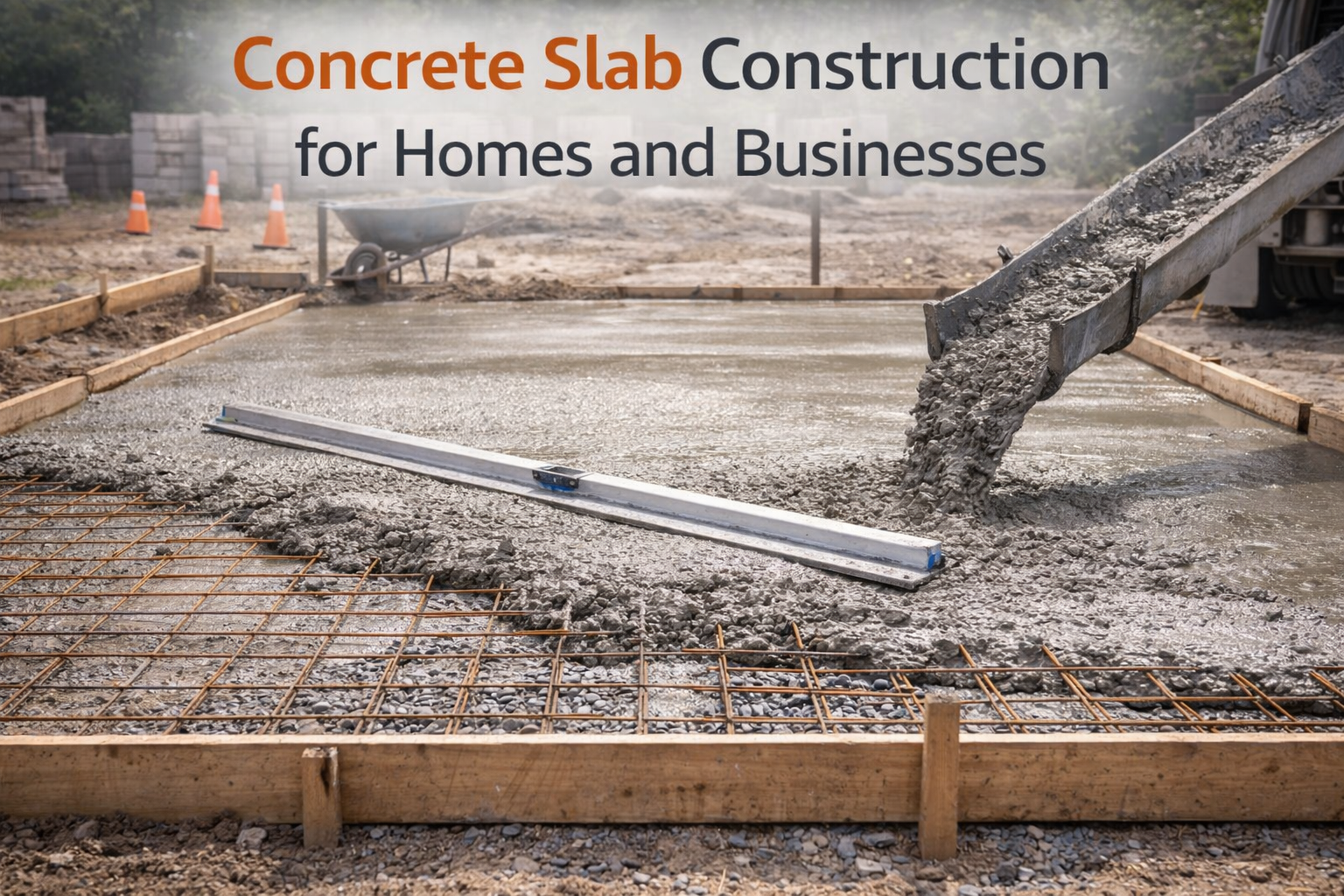
Concrete slab construction is one of the most common and reliable building methods used in both residential and commercial projects. From homes and extensions to warehouses, offices, and retail units, a well-built concrete slab provides the strength and stability that every structure depends on.
If you are actively planning a build and comparing options, this guide explains how concrete slab construction works, why it is so widely used, and what to consider before starting. The goal is to help you make informed decisions that protect your budget and your building long term.
A concrete slab is a flat, horizontal surface made from poured concrete that forms a foundation or base for a structure. It spreads the load of the building evenly across the ground and creates a stable platform for walls, floors, and equipment.
Concrete slabs are used in houses, garages, shops, factories, and commercial buildings where durability and load-bearing strength are essential.
Concrete slab construction is widely used because it offers a strong balance of performance, cost efficiency, and versatility.
A properly installed slab can handle heavy loads, resist movement, and last for decades with minimal maintenance. It also works well with modern building methods and materials.
For both homes and businesses, slabs provide a clean, level base that simplifies construction and improves long term reliability.
Not all concrete slabs are the same. The type used depends on the structure, soil conditions, and intended use.
This slab sits directly on prepared ground and is commonly used in residential homes and small commercial buildings.
It is suitable where soil conditions are stable and loads are evenly distributed.
A suspended slab is supported by beams or walls rather than resting directly on the ground.
This type is often used in commercial buildings, multi-storey structures, or areas with poor ground conditions.
Reinforced slabs include steel mesh or rebar to increase strength and control cracking.
They are commonly used in driveways, workshops, warehouses, and commercial spaces with higher load demands.
Concrete King regularly supplies materials and guidance for reinforced slab projects where strength and durability are critical.
Understanding the construction process helps ensure quality and avoid costly mistakes.
The process starts with assessing soil conditions and clearing the site. Excavation is carried out, and a compacted sub-base is installed to provide support.
Good ground preparation reduces movement and helps prevent cracking later.
Formwork defines the slab shape and depth. Reinforcement is added based on load requirements and building regulations.
This stage plays a major role in the slab’s long-term performance.
Once preparation is complete, concrete is poured and levelled to the correct thickness. The mix used depends on the slab’s purpose and expected loads.
Suppliers like Concrete King help ensure the right concrete mix is used for both residential and commercial slab construction.
The surface is finished to the required level and texture. Proper curing allows the concrete to gain strength gradually.
Rushing this stage can weaken the slab and reduce its lifespan.
In residential projects, concrete slabs are often used for house foundations, extensions, garages, and garden buildings.
Insulation and moisture barriers are important for comfort and energy efficiency. The slab thickness and reinforcement must match the building design and local regulations.
Working with experienced professionals helps ensure the slab meets both structural and thermal requirements.
Commercial slab construction often involves higher loads, larger surface areas, and stricter standards.
Warehouses, factories, and retail units may require thicker slabs, stronger concrete mixes, and additional reinforcement.
One common mistake is poor soil preparation. Even the best concrete will fail if the ground beneath it is unstable.
Another issue is using the wrong concrete mix. Over-specifying increases costs, while under-specifying risks structural problems.
Ignoring curing times is also a frequent problem. Concrete needs time to reach full strength, and early loading can cause permanent damage.
A concrete slab is not an area where shortcuts pay off. The slab supports everything above it, and repairs are difficult and expensive once construction is complete.
Using trusted suppliers and experienced professionals reduces risk and ensures the slab performs as intended.
Concrete King is known for supplying high-quality concrete and offering reliable guidance for both domestic and commercial slab projects.
The required thickness depends on how the slab will be used. Residential slabs are usually thinner, while commercial and industrial slabs often need greater thickness to handle heavier loads. Soil conditions and building design also play a role, so this is best confirmed during planning.
Not every slab needs heavy reinforcement, but most benefit from some form of steel mesh or rebar. Reinforcement helps control cracking and improves long-term strength, especially in areas with vehicle traffic or heavy equipment.
Concrete begins to set within hours, but proper curing takes time. Light foot traffic may be possible after a day or two, but full strength develops over several weeks. Loading the slab too early can cause lasting damage.
Concrete slabs can be built on many ground types, but the soil must be properly assessed and prepared first. Poor or unstable ground may require extra excavation, a stronger sub-base, or a suspended slab design.
Yes, as long as the slab is designed with future use in mind. Factoring in potential extensions or heavier loads at the planning stage helps avoid expensive upgrades later.
Concrete slab construction remains one of the most dependable foundation solutions for homes and businesses. Its strength, versatility, and long lifespan make it a practical choice for a wide range of building types and environments.
Understanding slab types, construction stages, and material choices helps you plan more effectively and avoid common issues that lead to delays or added costs. Whether you are building a home, expanding a business space, or developing a commercial property, the quality of the slab will directly affect the success of the project.
Taking time to work with experienced suppliers and seeking informed advice can make a significant difference. Concrete King offers the materials, experience, and practical support needed to deliver concrete slabs that meet real-world demands.
Whether it’s the amount of ready mixed concrete to be used for concrete slabs, or working out how much needs to be combined with coarse aggregate, we’ve got the solution.
To place your order or to discuss your requirements further please contact our friendly team today who will be happy to help with the concrete mix calculator.
Visit our Concrete Calculator page where you can access more calculate options.